



Your next customer just spent an hour researching motorhomes. They compared three brands. They evaluated floor plans, chassis types, and warranty coverage. They asked follow-up questions about towing capacity, long-term reliability, and which models hold their resale value. The AI platform built them a side-by-side comparison table of three diesel pushers with price, chassis, warranty length, and owner satisfaction, and then generated a pros and cons breakdown for each one. By the end of the conversation, they had progressed from browsing to a shortlist and an initial frontrunner.
They did all of it inside ChatGPT. They got everything they needed without needing to visit your website.
This isn’t a hypothetical. It’s happening right now. And for manufacturers who sell through dealers, the implications are more drastic than most people realize.
For years, the research phase has been the one part of the buyer journey where OEMs have had the most direct influence. Before a buyer ever stepped on a lot, they were visiting your website, watching your walkthroughs, and using your shopping tools. But that phase (and the brand preference it helped build) is slowly being pulled out of your direct control.
And that means there are now two places where brand preference is built—during research and on the lot—that are moving further from your direct control.
What “AI search” actually means and what it looks like
When someone types “best luxury pontoon boat” into ChatGPT or Google today, they don’t get a list of ten blue links to click through. They get an answer. A synthesized, conversational recommendation that names specific brands, compares features, and forms a narrative, all without the user ever visiting a manufacturer’s website.
That answer is built from Reddit threads, YouTube video descriptions, forum discussions, dealer blog posts, and third-party review sites. It pulls from dozens of sources, synthesizes them into a single response, and delivers it in seconds. The user reads it, maybe asks a follow-up question, and moves on. At that point, brand preference is already forming.
For brands, the question becomes: how do you make sure you’re part of that answer? The practice of doing so is what the industry calls AEO (Answer Engine Optimization)—optimizing your brand’s presence for a world where the search engine gives the answer instead of a list of links. And the shift is happening fast.
Here’s what the data says:
- 92–94% of Google AI Mode sessions result in zero external clicks. Users get what they need and never visit your website. (Source: SEMrush – Google AI Mode’s Early Adoption and SEO Impact)
- Organic click-through rates drop 61% when an AI Overview appears. Position #1 in Google used to get a 7.3% CTR. Now, with an AI Overview present, it gets 2.6%. (Source: Search Engine Land – Google AI Overviews drive 61% drop in organic CTR)
- 60% of all searches now result in zero clicks, and that number is climbing. (Source: SparkToro – Zero-Click Search Study)
- ChatGPT alone processes 2.5 billion prompts daily. And that’s just one tool. There are plenty of others, and they’re turning into a primary research channel. (Source: TechCrunch – ChatGPT Daily Queries)
And here’s the most eye-popping stat: AI results are driving less than 1% of referral traffic back to websites. The conversations about your brand haven’t stopped. They’ve moved somewhere you can’t see, have less control over, and right now probably can’t measure.
Google AI Mode Impact: Organic Branded Search Impressions vs Clicks
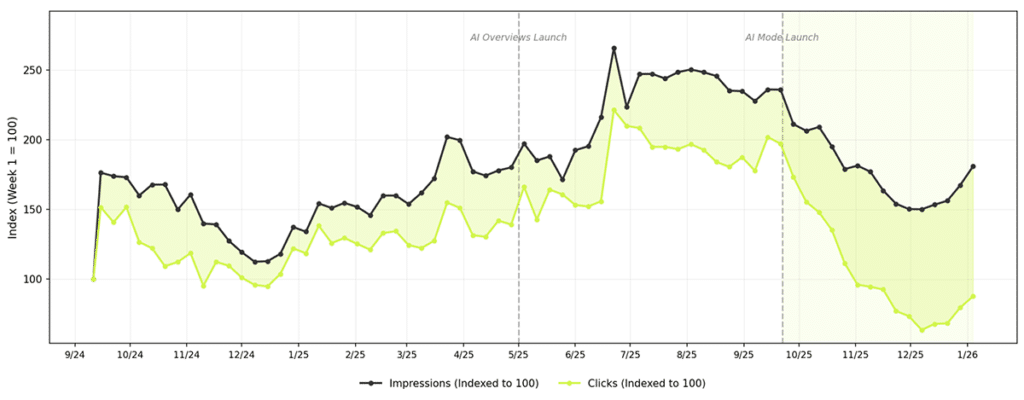
We’ve seen this pattern across multiple manufacturer brands. The number of times your brand is being served in search results (your impression volume) holds relatively steady, but clicks have declined significantly. The gap between those two lines is the research happening in AI (in this instance, Google AI Mode) about your brand, your competitors, and your category but never touches your website.
Why this hits manufacturers harder than everyone else
Every marketing team is dealing with this shift. But here’s what makes it uniquely painful for OEMs who sell through dealers:
You were already fighting a two-front battle.
On one front, you’ve been battling at the point of sale for years. Your products sit on mixed lots next to three, five, or ten competing brands. A sales rep who knows the competitor’s product better than yours can steer a buyer away in 30 seconds. You’ve invested in brand building, enablement, co-op programs, and dealer training to win that battle, and it’s an ongoing fight.
On the other front, you had digital research. Not just your website but the whole ecosystem. Your product pages, your YouTube walkthroughs, your comparison content, or the social media discussions you could at least monitor and influence. This was where brand preference formed before a buyer ever stepped on a lot. And it was the part of the customer journey where the manufacturer, not the dealer, had the most direct influence.
AI is collapsing that second front.
It’s not just that fewer people are clicking through to your website. It’s that the entire digital research phase across every channel is being compressed into AI-generated conversations that synthesize information from sources you may not control or even know about. The buyer still does the research. They just do it differently now.
To state it plainly, the window where you can influence brand preference is shrinking from both sides, and the method buyers use to form that preference is fundamentally changing.
That puts a lot at stake because, as you know, when you build strong brand preference during those months of research, a buyer walks onto a mixed lot already knowing what they want. In that case, even if the exact model isn’t available or the price is higher than expected, brand-loyal customers stay within the brand family. They’ll look at a different model or floor plan. They’ll drive to a different dealer. They won’t get steered to a competitor.
When research happens in AI and your brand isn’t well-positioned in those answers, the buyer either a) forms a preference for a different brand or b) walks onto the lot open to anything. And you’re relying on the dealer to sell your brand over every other brand sitting next to it
What manufacturers should do about it
The good news: this is solvable. The playbook is emerging, and the brands that move first will build a real competitive advantage. We’d prioritize these in order of impact:
1. Create the content AI actually uses
This is the most important move. Not all content carries equal weight in AI-generated answers. The generic brand content most manufacturers produce, like “our commitment to quality,” or “explore our lineup,” is essentially invisible to AI. What AI actually cites and mentions is:
- Comparison content – brand vs. brand, model vs. model, category vs. category. “Class A vs. fifth wheel for retirement travel.” “Which luxury diesel pusher has the best ride quality?” Buyers are asking these exact questions in AI right now. If you haven’t answered them, someone else’s answer, like a Reddit thread, gets used instead.
- Technical deep-dives with proprietary detail – chassis engineering, construction processes, material choices. AI rewards specificity and authority. A page about your proprietary suspension system that explains how it works and why it matters will outperform a generic “quality craftsmanship” page every time.
- FAQ content built around real buyer questions – “Is [brand] worth the premium price?” “What’s the warranty coverage on [product]?” “Best [category] for families?” Structure your answers in a what/how/why format that AI can easily parse and surface.
- Lifestyle and use-case content – “Best RV for full-time living,” “which boat is right for coastal fishing,” “Class C vs. entry-level Class A for first-time buyers.” This is where early-stage research happens, and where brand preference starts to form.
- Authentic owner stories and real-world experiences – content that feels human, real, and is hard to replicate. The kind of content AI can’t generate on its own.
Here’s some nuance: AI increasingly rewards what the industry is calling “additive content.” Think original insights, real owner stories, and proprietary data over generic evergreen definitions that just explain a category. Anyone can write “what is a Class A motorhome?” AI doesn’t need your version of that. But it does need your version of “why our Super C chassis handles crosswinds differently than anything else on the market.” That kind of content, rooted in what you actually know and what your customers actually experience, is what earns mentions, builds authority, and shapes the narrative AI delivers about your brand.
2. Your owners’ experience is now a marketing channel
This might be the most underrated shift. Reddit is the #1 most cited domain in Google AI Overviews, accounting for 21% of all citations. YouTube is #2 at 18.8%. Across all AI platforms, earned media (forums, reviews, and user-generated content) accounts for nearly half of all citations.
What that means: the experience your owners have and whether they talk about it publicly, directly shapes what AI says about your brand.
When an owner posts on a forum about an exceptional service experience, that becomes training data. When they post a YouTube short of their new unit, that becomes a citable source. When they complain about a warranty claim on Reddit, that becomes part of AI’s brand perception, and negative impressions are disproportionately sticky in AI systems.
It goes much deeper than “please leave us a review” or “tell us about your ownership experience.” This is about the entire OEM-dealer ecosystem creating experiences worth talking about. It connects brand building, dealer enablement, post-purchase communication, and owner community development into a single, interconnected system because AI treats all of it as input.
Manufacturers already investing in owner lifecycle programs, community building, and dealer service quality will find that those investments now pay dividends in a way they never expected with AI visibility.
3. Get your brand into the sources AI draws from
Your website is just one source. AI draws from many. If you’re only optimizing your website, you’re competing for one seat at a table with a dozen seats.
- YouTube – Video content was cited heavily across every AI platform we tested. Optimized titles, descriptions, chapters, and links back to your site make a real difference.
- Dealer content – Large dealers are producing massive amounts of content: walkthroughs, comparisons, reviews. Equip your best dealers with brand-accurate media kits, so when their content gets cited, your brand is positioned correctly.
- PR and industry media – AI cites industry publications, independent reviews, and editorial content. Strategic media placements put your brand into the ecosystem AI draws from.
- Forums and communities – 99% of Reddit citations in AI point to unique discussion threads, not brand profiles. The conversations happening in owner groups, subreddits, and industry forums directly influence what AI tells your next buyer.
4. Build the technical foundation
AI systems can only surface your brand if they can understand your content. The technical basics still matter, and a lot of manufacturers haven’t done them:
- Schema markup – structured data that tells AI systems “this is a product,” “this is a feature,” “this is a price.” These are table stakes that few in outdoor recreation or commercial vehicles have already implemented.
- Clean site architecture – relevant headings, semantic keywords, internal linking, proper URL structures. AI engines rely on traditional search indexes as their foundation. If your site doesn’t rank organically, AI is already less likely to cite you.
- Un-gate your content – AI can’t read a PDF spec sheet behind a form. So information that sits behind forms never makes it into AI-generated answers.
5. Measure what actually matters
The old scoreboard of organic traffic, keyword rankings, and click-through rates no longer captures the full picture anymore. Layer in:
- AI visibility scores – how often and how favorably your brand appears across AI platforms
- Mentions vs. citations – a mention is when AI names your brand in its answer, and a citation is when your website appears as a source link. Both matter, but mentions are the more valuable metric.
- Share of voice in AI responses – when someone asks about your category, how often does your brand come up relative to competitors?
- Branded search volume – if AI is building awareness for your brand, you’ll see it reflected in branded search volume over time
Track these alongside your traditional metrics. The brands that can tell their leadership team, “here’s how we’re showing up when buyers ask AI about our category,” will have a real strategic advantage.
Your buyers are there; the question is whether you are
The gist: consumers are shifting how they research high-consideration purchases. They’re spending months forming opinions inside AI-powered tools before they visit a website or walk onto a lot. And that shift is accelerating.
And few in outdoor recreation or commercial vehicles are adapting to it at the same rate as their consumers. So there’s an enormous opportunity. The manufacturers who invest in content strategy, technical foundations, owner experiences, and distribution will be meeting their buyers where they’re at.
For manufacturers who’ve spent years building brand preference through product quality, dealer relationships, and marketing investment, this isn’t about starting from scratch. It’s about extending those efforts into the channels where your buyers are now forming their opinions.
The brands that show up there won’t just win brand exposure. They’ll win the preference that carries buyers through the door.
Related Resources: