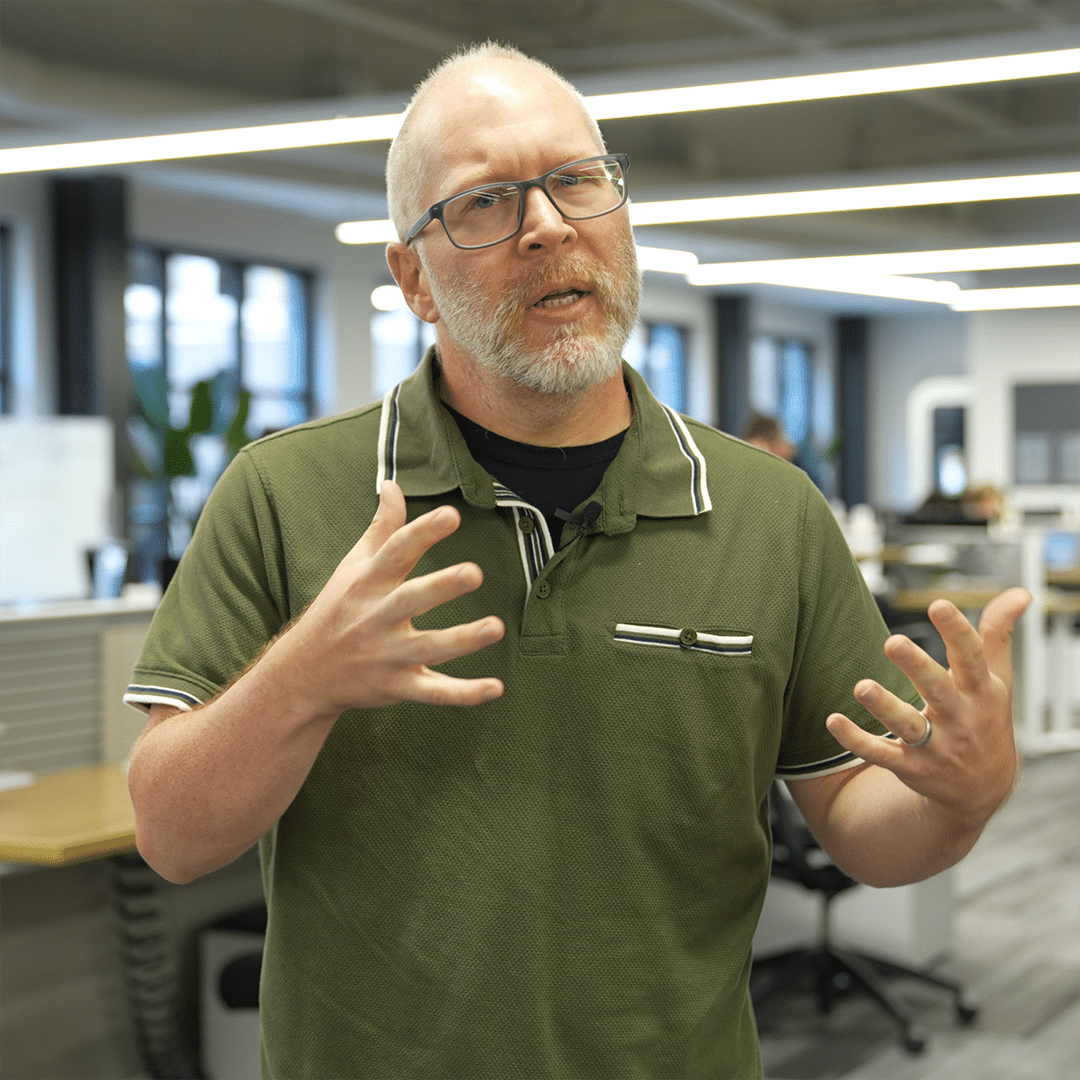


Pioneering B2B Brand Strategy at Ford Pro with Iain Lanivich
Why You Win
This Episode
Translating a retail icon into a commercial brand means harnessing great creativity, vision, grit, and a deep understanding of your customer.
In this episode, John and Kyler sit down with Iain Lanivich, Head of Brand, Creative, and Content at Ford Pro, to explore how he helped build the Ford Pro brand from the ground up. Coming from an agency background, Iain shares the surprises and challenges of operating in a corporate system not always built for creativity, and how he found ways to make it work anyway.
You’ll hear how he made the case for big ideas inside a risk-averse environment and why he believes “pre-selling” internally is the only way innovative creative gets off the ground.
Key Takeaways:
- Pre-sell Bold Ideas: Don’t wait for permission. Introduce creative thinking early so the assignment is shaped around the idea, not the other way around.
- Brand Means Productivity: Ford Pro is about saving time, cutting costs, and getting more done. Feeding that into their brand ensures customers experience them the way they want to be experienced.
- Educate to Differentiate: From dealers to internal engineers, brand storytelling needs to align everyone around the same narrative, even if they’ve been doing it the same way for decades.
Episode Transcript
This transcript was generated with the help of AI and may contain some errors.
[00:00:00] Iain Lanivich : If you wait for the assignment, you’re too late, You gotta start thinking about it in advance, pre-selling that concept in advance so that by the time the assignment hits, the assignment is written through the lens [00:00:10] of the way you want it to work. For your idea,
[00:00:14] Kyler Mason: whether you’re going to market through dealers, distributors, or some other partner channel.
[00:00:18] Kyler Mason: The mediated sale is complex. [00:00:20] We call it B2B two X, but the leaders in the industry are the ones who are making it look simple. I’m John Goth, and I’m Kyler Mason, and this is why you [00:00:30] win. Presented by Element Three,
[00:00:31] John Gough: Iain Lanivich is the award-winning executive creative leader at Ford Pro. He’s the head of brand, creative, and content, and he’s [00:00:40] got an awesome story because he comes from a full career on the agency side of the business.
[00:00:45] John Gough: Where he was telling stories and building brands and entered Ford Pro [00:00:50] several years ago just as that brand was launching. And so he talked to us about different experiences that he’s had and opportunities that he’s had to define the [00:01:00] brand and build the brand and make it resonate with the retail side of the house, as well as creating some separation and a unique identity for the brand.
[00:01:08] John Gough: He’s got a great background in [00:01:10] building these creative teams and a really unique perspective that we really enjoyed. So in this podcast, you will also hear what Ford Pro actually stands for, and it’s not what you think. I hope you [00:01:20] enjoy. Ian, we’re so grateful to have you with us today. Thanks for joining us.
[00:01:24] John Gough: Great. Can wait. So, we haven’t had a lot of creative leaders on the podcast that we’re [00:01:30] looking forward to this ’cause it’s a different angle for us. Talk to us about the role that you sit in at Ford right now.
[00:01:35] Iain Lanivich : Yeah, I, I’m in charge of all brand creative for Ford Pro, So if it’s got a Ford Pro logo on [00:01:40] it, I’m an approver.
[00:01:41] Iain Lanivich : That’s advertising, that’s branding, that’s CRM, that’s email, that’s events, you name it in this role have gotten a lot more event work than I had previously in my career, [00:01:50] but. Luckily for me, I think I had a career that I started in digital when it was really just web and then advertising hit and then kind of learned [00:02:00] branding, learned advertising learned, social media did pr.
[00:02:03] Iain Lanivich : So by the time I came in this role. It was I was able to speak to all of it. You gotta be an entrepreneurial creative director. If you [00:02:10] grew up in a large ad agency, large agencies kind of pigeonhole their teams. It’s basically you have specialists in digital or CRM or websites or national advertising or whatever.[00:02:20]
[00:02:20] Iain Lanivich : And there’s many people that I’ve interviewed throughout my career that basically come in, they’ve got three years on the job, and their book is email design, [00:02:30] right? And first they landed their first gig at a big shop, graduated college, got asked on day one, can you lay out these emails? And three years later, they’re in the CRM [00:02:40] team knocking out emails.
[00:02:41] Iain Lanivich : For me, the way my career worked, being able to work across a lot of different things, new business assignments or RFPs and stuff, they all take a different approach, a different angle, and when you come into the [00:02:50] corporate side, I was maybe under the assumption when I came over here that I felt clients had an understanding of how you build brands and how you build campaigns and how you [00:03:00] organize all these types of things.
[00:03:01] Iain Lanivich : And that’s not always the case. If you’ve got somebody that got hired in that came from a shop that did everything entirely in-house, never worked in [00:03:10] a complex corporate environment with large corporate agency structures, they don’t know what they can ask an agency to do. They don’t know these different roles.
[00:03:17] Iain Lanivich : So I think for me, it was as a [00:03:20] creative director by trade, my job is to create consistency, maintain quality, maintain integrity of an idea, and try to. Permeate that idea across as many channels as I can [00:03:30] possibly do. give it as many legs as possible. So I think for me, it’s when I came over I was thinking, oh, it’s a great opportunity when you work agency side, it a lot of times feels it’s moving so fast, but you’re [00:03:40] really only focused on your scope.
[00:03:41] Iain Lanivich : and maybe you might pitch some concepts or stuff like that that fall outside of it, how this idea could work beyond what your assignment is. But there’s no real expectation that [00:03:50] those things are going to happen, and it’s kind of up to your client if they’re going to go get another department outside of theirs to fund that or to take ownership of it.
[00:03:59] Iain Lanivich : So I [00:04:00] thought one of the things coming in was gonna be like, wow, I’ll have access to all of that. How do you make a brand come to life Across everything training. [00:04:10] Sales, everything. You’re not thinking about a lot of the times when you’re working on an agency side or you’re just focused on a social media scope or an advertising scope or things like that, but then you realize how massive it is and [00:04:20] how overwhelming it can be, and I think that was a pretty big learning curve.
[00:04:24] Iain Lanivich : When you have engineers that build things on vehicles reaching out to you directly [00:04:30] because they see your title and they don’t really know what you do, but they see you as an opportunity to basically get their story shared and you’re coming in. Not knowing if you should [00:04:40] even be taking that meeting or not.
[00:04:41] Iain Lanivich : So you’re just taking all those meetings and you’re hearing from all these people and you’re what do I do with this information? The first three months people set up so many one-on-ones with me and I’m I [00:04:50] don’t even really funny moment. I had all these one-on-ones and my day two in the corporate world was a completely packed calendar from nine to five, no [00:05:00] gaps.
[00:05:00] Iain Lanivich : Day two heat of COVID working where you’re not leaving your seat at all. You’re trying to find a moment to run downstairs to go to the bathroom and come back before anybody even notices, right? [00:05:10] And all that’s happening. And I’m just bouncing, meeting to meeting. And it was I remember I bounced into this one-on-one.
[00:05:16] Iain Lanivich : And I start talking to this guy and he’s sitting there with a hoodie and we’re just chatting and I’m [00:05:20] thinking, in my head, I’m I don’t even know who this person is. And then at some point in time, early in the conversation, I’m so tell me about what you do. And he just kinda looked at me and laughed.
[00:05:28] Iain Lanivich : He goes. I’m your [00:05:30] CFO and I just started laughing and I’m look at me. I got blue hair and piercings and you’re sitting across from me as my CFO in a hoodie.
[00:05:38] Kyle Mason: Yeah, this is [00:05:40] cool.
[00:05:40] Iain Lanivich : but I didn’t even, I, I didn’t even have the time right outta the gate to even look up who am I meeting with?
[00:05:46] Iain Lanivich : there was just so many different people.
[00:05:48] John Gough: I mean, how awesome to come into [00:05:50] a role and be so highly sought after. Did you have a predecessor or are you the first one in the role?
[00:05:54] Iain Lanivich : Well, when I started Ford Pro was brand new. Right. It was my first time working [00:06:00] on fleet, but I grasped the concept of it very quickly.
[00:06:03] Iain Lanivich : I came into this role thinking that I’m basically just leading creative, really ended up becoming a subject matter expert for [00:06:10] Ford Pro, right? I, I learned the products, I learned the relationships of the products. I learned how this thing works together with this thing in order to improve your uptime, right?
[00:06:18] Iain Lanivich : But internally, within Ford, [00:06:20] you have one group that’s working on this product, one group that’s working on this product, and it requires somebody to realize, wow, if we bring these two things together. We can, offer our customers a better [00:06:30] solution. So in going through defining the brand, defining the way that we are gonna start to story tell, but yeah, there was not much time to figure out the brand, figure out the strategy behind [00:06:40] the brand, make it come to life through art and copy, put it through the lens of, why would journalists care in order to launch a media event, get our agencies up to speed and everybody else involved [00:06:50] up to speed launch it.
[00:06:51] Iain Lanivich : And then turn around and do the same thing for a customer audience, right? And in doing all that, it helped cross train employees [00:07:00] and everybody else involved and how we should talk about this and how these things work together. So I really developed strong relationships with our sales teams, with our dealer [00:07:10] teams, with our software teams, and everybody else involved.
[00:07:13] Iain Lanivich : And it’s been fun.
[00:07:14] Kyle Mason: You’re getting a full set of experiences in change management, it sounds like unexpectedly.
[00:07:19] Iain Lanivich : I [00:07:20] think that’s what it kind of what makes it fun though, right? It creates tension. It creates some anxiety. Yeah. but when I look back, even the assignment I’m working on right now. It’s pretty much [00:07:30] every large assignment I’ve ever worked on that has high quality, has a creative lens on it or some type of clever creative angle on it is complex.
[00:07:38] Iain Lanivich : It always has [00:07:40] these tension moments, And you just gotta stay focused on the end result, especially as a creative, At the end of the day, the stuff you see. Regardless of what it is, that’s the stuff that you’re [00:07:50] producing. So all the planning that went into it, all the strategy that went into it doesn’t matter if that end thing doesn’t come to life the way that it needs to, and it isn’t perceived [00:08:00] the way you want it.
[00:08:01] Iain Lanivich : So yeah, it’s all projects to me.
[00:08:03] John Gough: So when you’re taking a household name. In a retail environment and translating that brand into [00:08:10] commercial vehicle. Talk to us about the thing that was running through your head. How do you create distinction separation? What are you worried about or thinking about and you’re in that brand moment?[00:08:20]
[00:08:20] Iain Lanivich : Yeah. Drinking from a fire hose. I grasp the concept of the story of Ford Pro, what we wanted it to be, and that’s what we translated into the branding. But at the same [00:08:30] time, I was learning fleet. I was learning commercial. I didn’t know much about upfitting. I’m still learning today, but I feel like I accelerated that learning in that first year to two years.
[00:08:39] Iain Lanivich : It’s [00:08:40] difficult because your customer, in most cases, your customer is buying your vehicles, whether or not they’re buying your software, other services, or subscribing to them, or using your [00:08:50] financing or stuff like that. It starts with your vehicles. And luckily for us, we have the, the largest market share in the commercial space,
[00:08:57] Iain Lanivich : So you could pretty much look at [00:09:00] any fleet out there, and most of ’em have a Ford vehicle in their lineup, and most are mixed fleets, And we know that. So our products are built so that they can work regardless of, what [00:09:10] brand you’re driving. It’s all about Ford Pro is there for businesses and there to help you with your fleets.
[00:09:13] Iain Lanivich : And we understand that you might not have a hundred percent Ford lineup, but to your customers. They [00:09:20] interface with Ford most of the time, not Ford Pro, Mm-hmm. So you’re not gonna have a Ford Pro badge on the vehicle, It’s got a Ford badge. You’re going to a Ford dealership. So we [00:09:30] have to work a little bit harder to help ’em understand what Ford Pro is.
[00:09:33] Iain Lanivich : And I think we’re not flooding the airwaves in NFL football with Ford Pro advertising, right? A lot of this is [00:09:40] happening through customer relationships with our sales teams, local advertising, very targeted advertising to small business customers. ’cause that was one of the big reasons for Ford [00:09:50] Pro is you had the OEMs that have sales reps that talk with the national accounts.
[00:09:55] Iain Lanivich : But a lot of the products we offer could be very beneficial for a [00:10:00] business that maybe has a five vehicle fleet and they’re a plumber, right? The only people talking to them is the dealers, and we love our dealer network, but they might not be talking about the range of Ford Pro solutions with We Ford Pro is new.
[00:10:09] Iain Lanivich : We have to educate [00:10:10] them on that. So it was really how do we make sure that we. Help our customers understand that Ford Pro isn’t like an add-on. [00:10:20] It’s not like just the software you can subscribe to. It stands for commercial and business expertise, right? It’s if you are starting a new [00:10:30] business.
[00:10:30] Iain Lanivich : And you aren’t exactly sure what type of configurations of vehicles you need in order to fund and finance to start your business, we will help you with that. If [00:10:40] you don’t know what is the best option, from an Upfitting standpoint, we will help you with that. We’ll help you understand how to have the most uptime when it comes to service.
[00:10:48] Iain Lanivich : It’s helping people understand that it’s [00:10:50] Ford for business. It’s not just, even internally, it’s when you look at the rest of our lineup, an explorer. It’s not considered a, core commercial vehicle, but there’s a lot of people [00:11:00] in Ford that don’t realize Ford Pro sells explorers too, right?
[00:11:04] Iain Lanivich : Because it’s if you’re using it for business and it’s the right option for you, for whatever it is you’re doing, then you’re our customer and we [00:11:10] still have to help you, help guide you through whatever other aspects of managing your fleet.
[00:11:14] John Gough: Do you find that the carry on from the retail brand experience is more [00:11:20] helpful or is it sometimes confusing for some of your business customers?
[00:11:23] Iain Lanivich : Having experience in automotive, especially complexities of US [00:11:30] Automotive or North American automotive. When you get into how the dealers work, when you get into the different types of tier two advertising, tier three advertising, [00:11:40] sales events, all these other types of things that are just kind of tried and true and have been around in automotive for quite some time.
[00:11:46] Iain Lanivich : But if you’re coming in, having only worked in [00:11:50] technology and all of a sudden you come into this space, it’s a huge learning curve. I had worked off and on in automotive for other brands for 20 plus years, [00:12:00] so I’ve interfaced with a lot of different aspects of auto and was able to navigate some of that and help others navigate that.
[00:12:07] Iain Lanivich : But I think from even a messaging standpoint, so [00:12:10] much of it is emotion. Right. It’s I’m trying to make you fall in love with this thing I’m trying to make. You just basically realize the feeling of when you get behind the wheel [00:12:20] or when you walk out of your house and you see what you have in your driveway, right?
[00:12:24] Iain Lanivich : So much of it is on that, right? And in the commercial space, what I think is difficult for a lot of [00:12:30] people to understand is the person that’s making the decision to buy the vehicle may never drive it and probably won’t ever drive it. Right. So it [00:12:40] is a tool transaction, right? I am buying tools. You know, for my business, that emotion, you know, maybe when you get down to a small fleet, our small business, right?
[00:12:49] Iain Lanivich : I grew up a [00:12:50] Ford guy and now I’m starting a HVAC company. And basically we’re gonna start with Ford vehicles. And then as you grow, maybe you might start hitting a point where you realize at this moment in [00:13:00] time the offer is better on something else and I need to go with that, right? So you start to mix your fleet, but when you get higher in size of vehicles across the brands, that emotion gets less and [00:13:10] less and less.
[00:13:11] Iain Lanivich : Right. So it has to be all about being straight. It’s not being clever and cute to this audience, not understanding what they already know. Mm-hmm. [00:13:20] Because it’s a lot of times different teams, internally and externally, they get excited about something Upfitting, oh, that’s so exciting. You can customize your vehicle.
[00:13:27] Iain Lanivich : And it’s yeah, this customer already knows [00:13:30] that they already understand that. I don’t, I don’t need to tell them that I can customize transit van. Right? So I think it’s those types of things, the [00:13:40] differences of how you present messaging to a commercial audience versus a retail audience is very different.
[00:13:46] Kyle Mason: How do you make that energizing and fun if you’re coming from a [00:13:50] place where emotion sounds fun and glamorous? Very creative, how do you find inspiration in the fact that the message you’re talking about needs to be a little more [00:14:00] direct? It needs to be more business-minded. It needs to speak to the things that are, you said, it’s solving a specific problem and it’s
[00:14:06] Iain Lanivich : a tool.
[00:14:07] Iain Lanivich : You know, I, I mean, I’m a creative, [00:14:10] right? I want it to be interesting to me. I want to get excited about it, right? We had an event a few months ago where we brought some of our largest customers in, and we kind of helped ’em understand everything that we [00:14:20] were offering and what had evolved since we did this event several years ago.
[00:14:24] Iain Lanivich : Typically, at events, you might have keynote presentations, you might have breakout sessions, things like that, and breakout [00:14:30] sessions. When I go to them most of the time in pretty much any type of event, it’s usually death by PowerPoint. And PowerPoint’s got a purpose. It’s the fluent language of corporate America.
[00:14:39] Iain Lanivich : So you gotta [00:14:40] know it, you gotta speak it fluently. But if you can figure out how to retool what you’re trying to communicate through a more interesting way, that could be a way to [00:14:50] deliver info. So at our last event, we had three breakout sessions. And we put ’em through the lens of game shows.
[00:14:58] Iain Lanivich : So it was basically how do [00:15:00] we basically take the, the linear story that our subject matter experts are already ready to present and they’ve done this without having to think about [00:15:10] and they know what it is. And without completely overhauling their world. How do I put it through the lens of a game show where it feels random, it feels [00:15:20] different, it feels spontaneous, but it’s still the same linear story that was in the script, just to be honest.
[00:15:25] Iain Lanivich : I remember people were nobody’s gonna wanna pay attention to this. we’re, we’re doing all this extra work to [00:15:30] figure out how to gamify a presentation. And when we did it in our post-event survey, that content rose to the top on the feedback. Because it just was such a [00:15:40] break in the dryness of what they experience every day in their jobs that it created some laughter, it created some unexpected moments for them.
[00:15:47] Iain Lanivich : And it was cool. And it was fun. [00:15:50]
[00:15:50] John Gough: Yeah. And as a brand guy, you’re like, I got the impression, I got the attention. And they’re not gonna remember all the PowerPoint anyway. They may or may not remember all of the game show, but. [00:16:00] Were they gonna remember that they had a great experience with Ford
[00:16:02] Iain Lanivich : Pro? Yes.
[00:16:03] Iain Lanivich : Yeah. Or that we’re trying something different. We’re trying to help ’em understand something in a different way. I mean, I think a lot of people in the commercial [00:16:10] space have been in this industry for a really long time. They grew up in this industry. They know it really well. They have longstanding relationships with their customers.
[00:16:17] Iain Lanivich : If you’re a dealer, you’ve been working with the same customers for a [00:16:20] long time. If you’re one of our national account managers, you’ve been working with the your customer for a really long time, you know, so I hate to use the term of like can’t teach an old dog new tricks type thing. But [00:16:30] that’s kind of the mentality.
[00:16:31] Iain Lanivich : So I see it as one of my jobs is to make everybody think different on these approaches or find that angle that can change it. [00:16:40] ’cause everyone’s pretty fine with keeping things the way they are. And I think that’s just something in, I used to say this on the agency side, sometimes you might have an idea that you just know is a no-brainer.
[00:16:49] Iain Lanivich : They should totally do this. [00:16:50] Right? And you put it in front of your client and it’s basically like, why isn’t it going anywhere? Are they just not understanding it? Do I need to present it to them again? And it might be because they don’t have [00:17:00] full control to pull off that idea, right? They might need to involve other groups, other teams, other budgets.
[00:17:06] Iain Lanivich : And I think the same thing happens internally, right? Like the system is built [00:17:10] to do things the way it’s always been done. So like as an agency creative, for example, when you’re asked to think outside the box. Yeah, when you get into the presentation and it [00:17:20] shows the clients that basically you can think beyond the norm, but the odds of them buying one of those things is really, really low.
[00:17:27] Iain Lanivich : Right. So I used to tell people like, if you [00:17:30] wait for the assignment, you’re too late, right? You gotta start thinking about it in advance, pre-selling that concept in advance so that by the time the assignment hits, the assignment is written through the lens [00:17:40] of the way you want it to work for your idea, right?
[00:17:42] Iain Lanivich : Because otherwise, in an agency, they know how to produce a TV spot. They know how to produce a website, they know how to produce banner ads and emails and all [00:17:50] that stuff. It’s the whole system pumps that stuff out. Come in there with some crazy experiential kind of idea or come in there with some app or come in there with something different.
[00:17:59] Iain Lanivich : And it’s all of a sudden [00:18:00] your project managers, your account teams, your production teams, everybody’s I don’t really know how to move this forward, your clients. And it requires somebody internally to really champion those [00:18:10] ideas and push through those walls. And I try to be that person on the corporate side now.
[00:18:15] Kyle Mason: And you’re saying internally, you mean either both agency side and
[00:18:18] Iain Lanivich : Yeah, I would say on [00:18:20] the corporate side it’s much more right, because you got, you got a lot more corporate structure. You’ve got a lot more standardized things and processes and scorecards [00:18:30] and measurable KPIs and all of that and that are being reported back.
[00:18:34] Iain Lanivich : So if you’re presenting an idea that is maybe competing against something that they already know, if I do this, I’m gonna [00:18:40] get this. It’s, is it really worth that risk? Because maybe my objectives this year account for me to deliver this, and if I do this thing, it’ll help with that. But if I do this other [00:18:50] thing, it’s the unknown.
[00:18:51] Iain Lanivich : Right. So risk taking, I think corporate America, just in general, for the most part, is risk averse. And I think creativity is the opposite of that, right? So [00:19:00] finding the balance of how to surface the right things, how to evaluate the creative that the various teams I work with are bringing to me. What makes sense to really bring [00:19:10] forward or why read the room, right?
[00:19:11] Iain Lanivich : If I bring this to anyone right now, are they gonna be why are you spending time on this? We’ve got this thing going on. So I think you really just gotta have an understanding of everything going on around you. What’s the [00:19:20] current priorities of the moment, and then always be looking for opportunities.
[00:19:23] Kyle Mason: Do you have a story of an assignment that you Did the legwork to socialize influence so that you had the buy-in before you [00:19:30] actually started in on it?
[00:19:31] Iain Lanivich : This is kind of, maybe falls in line with that, but a little different. In 2019. Before I started at Ford, one of my clients was Pier, Michigan travel [00:19:40] and tourism brand.
[00:19:41] Iain Lanivich : was very well known for many years, a really well known advertising, big award-winning from a brand standpoint, beautiful imagery, voiceover, well-written voiceovers. and it [00:19:50] created this perception in people’s minds that, Pure Michigan, it’s waterfalls, it’s trails, it’s, all of that experience pure Michigan.
[00:19:55] Iain Lanivich : But when you work on government business that it always goes up for review, even if everything’s going [00:20:00] amazing, right? Relationships could be awesome, work could be great, but it’s like it has to go up for review after a certain period of time. And it was one of those years. And the strategy we were working with [00:20:10] was how do you export the pier?
[00:20:11] Iain Lanivich : how do I, it’s how do I take the pier and bottle it up and get it out to people to encourage more people to come into Michigan for travel? So maybe people that, that grew up [00:20:20] in Michigan and moved away and you want ’em to come back, or how do you get people to extend their trips to turn a weekend trip into a week or turn?
[00:20:26] Iain Lanivich : Things like that. And I was thinking about like the amount of [00:20:30] people that go to sleep to sounds. Right. Sounds of nature and stuff like that. I’m what if we basically just created a sleep album for Pure Michigan and we basically recorded found [00:20:40] sounds and actual sounds of water and actual sounds of nature and everything you could think of within Michigan.
[00:20:44] Iain Lanivich : Right. And put it out as a sleep album and pitched this concept and it was like one of the 30 ideas we [00:20:50] went into the pitch with and we finally launched it. Over three years later, it was almost like no one really knew how to act on that right away. Where does it fall? I don’t know what my client’s [00:21:00] objectives or stuff like that were for the year.
[00:21:02] Iain Lanivich : I knew that idea fell in line with what we were pitching, but it took a really long time before it actually aligned with where their heads were at. [00:21:10] Two and a half years later, I get a call and it was, Hey, we need a proposal put together for how you would execute that sleep album. And what [00:21:20] we ended up doing, which was really interesting, was we aligned it.
[00:21:23] Iain Lanivich : So from a earned media standpoint, it was the hundredth anniversary of Michigan State Parks. So we’re okay, what if we collect [00:21:30] sounds from different state parks across the entire state so that that becomes a way to tie the earned angle into it, And then we got stuck because if we put it on the streaming platforms, we’re gonna collect [00:21:40] royalties.
[00:21:41] Iain Lanivich : And the government entity couldn’t collect royalties. So the I idea was ready to die. Because it was oh, so the angle [00:21:50] around that was to have real artists elect royalties. So what we did was we worked with a production house, the music house, awesome team [00:22:00] assemble sound. They’re amazing.
[00:22:02] Iain Lanivich : They started chatting through it and we realized there was a group of Michigan artists that were all in different categories, folk [00:22:10] music, hip hop, electronics, stuff like that, but they all dabbled in ambient and there was a subtle growth of ambient music. And so we did exactly that.
[00:22:17] Iain Lanivich : We send some sound engineers throughout the state. [00:22:20] They hit 10 different state parks. They came back with who knows how many sounds. We then cataloged those sounds. We briefed the 10 different musicians. And we mixed [00:22:30] a, a sunrise to sunset journey from start to finish listening session of the state of Michigan.
[00:22:36] Iain Lanivich : And it was, you know, we launched on all the streaming platforms in 2019. [00:22:40] It actually ranked, I think it was number nine on billboard on the new age chart. It was crazy. We were oh my God, we just ranked on billboard on the new age chart for Pure Sounds of Michigan. It’s really cool. It was an [00:22:50] example of we had a great idea.
[00:22:52] Iain Lanivich : It wasn’t, the time wasn’t right. Right, but it stayed a topic. It would get brought up every once in a while and stuff, and [00:23:00] it was in the client’s minds. And then eventually when the time was right, the client probably must have set aside some budget and stuff like that and said, let’s try this. Pure Sounds of Michigan idea.
[00:23:08] Iain Lanivich : And it worked. [00:23:10]
[00:23:10] John Gough: That’s awesome. Love that Hope springs eternal for marketing teams. After that story, they’re yes, it’s not dead yet. It’s not dead yet. And the thing that I have a question about, especially as you’re [00:23:20] coming from this agency environment and retail auto working with these dealers, and upfitters really this whole complex ecosystem that exists [00:23:30] in commercial vehicles.
[00:23:31] John Gough: When you are watching now, your peers come into this environment or people who haven’t worked in that before. What’s the key word that you give ’em? [00:23:40] What’s the big tip that they need to understand the complexity they’re walking into? You’ve
[00:23:45] Iain Lanivich : gotta learn it, you’ve got to talk with the people that are doing it every day.
[00:23:49] Iain Lanivich : [00:23:50] When you first walk into a brand and you don’t know much about that brand, and you haven’t worked with that brand, and maybe you ought to pitch that brand, You download their style guide, you get your hands on it, you stay to [00:24:00] it, You follow the rules. But once you know the rules, then you can start to figure out where do you bend the rules?
[00:24:06] Iain Lanivich : How far do you push ’em? stuff like that. Like I’m sure the person that [00:24:10] created the style guide has not applied that style guide to every type of creative across the brand, Their deliverable was a style guide. But to most people that [00:24:20] work on the brand, it is like that is fact.
[00:24:23] Iain Lanivich : That is, it is just assumed that all of that has happened. Like Upfitting. I had worked on truck advertising and stuff like that on the [00:24:30] retail side, but I, I hadn’t even really turned, heard the term upfitter. If I did, it just went over my head because I didn’t know what it was We have a product called the Vehicle Integration System 2.0.
[00:24:39] Iain Lanivich : When it first [00:24:40] started getting talked about internally, it was the only thing that I think people could really grasp of what that thing was is it lets you put buttons on the touch [00:24:50] screen in the vehicles that could do upfit controls. So I could basically tab, instead of me having to use one of the five switches or six switches that are in the overhead to turn [00:25:00] on a light in the back.
[00:25:01] Iain Lanivich : Or instead of me having to create a, a set of controls on the outfit and get outta my vehicle and walk around to turn those on, I can access the touchscreen [00:25:10] or the sink screens, the Ford sink screens to basically add new controls there. So now it’s, for example, if you have a police car and you need to turn on your sirens and turn on your lights, you’re not gonna start dabbling with the sink [00:25:20] screen to do that,
[00:25:20] Iain Lanivich : You’re probably gonna wanna flip a switch. But if you’re running into a situation where you have 10 different controls and there’s only five things that you could basically immediately [00:25:30] hit, You gotta prioritize, what do I really need to do right away versus what are things I can put in there?
[00:25:34] Iain Lanivich : Well, this opens that door for you. Everybody just was oh, you could put stuff on the sink screen. And it really took [00:25:40] until I, I was shooting a video and it wasn’t until I was literally on set and we were talking about the vehicle integration system 2.0, where it really hit me what this [00:25:50] was capable of.
[00:25:51] Iain Lanivich : It’s a way to program custom logic directly so you, the vehicle can talk to the upfit and the upfit can talk to the vehicle and they know what they’re doing. [00:26:00] So for example, if, if you, I’m driving my salt spreader and I pull up to a red light and I stop. And I forgot to flip the switch ’cause the salt is still spreading and there’s [00:26:10] a mound of salt now there.
[00:26:11] Iain Lanivich : And oh, I flipped it and I just start driving again and stuff. Oh, I’m driving fast. So now I’m only, it’s not a lot of salt is spraying right now. I’m driving slow. [00:26:20] Too much salt is spraying. With our vehicle integration system 2.0, you can actually program those two things to talk together.
[00:26:27] Iain Lanivich : So it’s the upfit, the salt spreader [00:26:30] knows that the vehicle is driving fast. So it says spray more salt, it knows it’s idle. Stop spraying salt, And it was just like. Wow. Once that unlocked in [00:26:40] my brain it was kinda like, look at any industry, look at any outfits, look at, look at any viral video of a person trying to drive a bucket truck.
[00:26:47] Iain Lanivich : Not realizing the bucket is still up and pulling [00:26:50] power lines down, It’s that integration system can program the logic where the Offit is telling the vehicle that the upfit is still in use, so don’t allow it to [00:27:00] move out of park. And those are things that obviously Upfitters deal with.
[00:27:03] Iain Lanivich : And they they have their own solutions of how they splice into the wiring harnesses and they do customization and [00:27:10] stuff like that. And this just became a way to make it easier for the outfitters. But we have to educate the outfitters, And we have to educate the customers to understand the potential of what they can do [00:27:20] so they can ask for those types of customizations, things like that, where.
[00:27:25] Iain Lanivich : Now when I think about Upfitting or now when I think about that product we offer, it’s [00:27:30] like I have a whole different way that I could take it or how I can educate a customer, how I can utilize that or create new scenarios of it. Somebody like an agency creative team that’s just coming in for the [00:27:40] first time and getting asked to put together something for the vehicle integration system, it’s like they’re gonna have no concept of that.
[00:27:45] Iain Lanivich : They’re gonna write about sync screens.
[00:27:47] Kyle Mason: Yeah. Yeah. I mean, you talked about [00:27:50] the emotion that exists in retail, but what you just talked about. There’s tons of it there. I mean, peace of mind pain, like you could fight against certain problems, just like getting the job [00:28:00] done better, faster, easier. There’s a lot.
[00:28:02] Kyle Mason: There’s a lot there.
[00:28:03] Iain Lanivich : Back to the branding standpoint for Ford Pro. Right off the bat, when people see the word pro Lysol, pro [00:28:10] lows for pros, it’s professional, And our branding is all about we power the growth in productivity of every business. Today and tomorrow. So it was how do we [00:28:20] get people to realize the word PRO stands for productivity in not professional.
[00:28:23] Iain Lanivich : Now, obviously, people are gonna always think professional but everything we do from a branding standpoint for the most part is to try to [00:28:30] help customers understand how they can be more productive, more efficient, save time, and hopefully lower their spend.
[00:28:36] Kyle Mason: I didn’t know that. I didn’t know that either.
[00:28:39] Kyle Mason: I have a question for [00:28:40] you. If you were to give coaching to an exec team in the, let’s say in the commercial space, how to set up a really good culture or platform for creative to [00:28:50] succeed and have the space it needs to do good work, what kind of coaching would you give?
[00:28:55] Iain Lanivich : I definitely come from the mindset that the [00:29:00] best work is when people are having fun doing it.
[00:29:03] Iain Lanivich : When you’re excited and rallying around of an idea, when you can see the potential of where an idea can go and you can help [00:29:10] others visualize that as well. You reach key milestones and there’s celebratory moments. I don’t necessarily mean you have to have a party for it, but it’s you gotta be excited [00:29:20] in the office or give some kudos.
[00:29:22] Iain Lanivich : But my understanding of the way corporate works is it’s the structure isn’t that There’s a lot of [00:29:30] pressure. There’s a lot of pressure around hitting things like earnings numbers, what do we commit to the investors, And then that trickles down to what are the priorities or the [00:29:40] objectives from a sales or a marketing standpoint.
[00:29:42] Iain Lanivich : And then that trickles down to the teams that are working on those things. To be efficient was in space balls take only what you need to [00:29:50] survive, That’s the mentality, It’s do you really need that? And I think there’s a lot of creative stuff that is considered more nice to have.
[00:29:58] Iain Lanivich : Right. You need to [00:30:00] figure out how to separate the pressure. From the teams that are doing the work and you need to create flexibility so that there’s [00:30:10] exploration baked into it. Sometimes it’s a fire drill, things changed. Maybe something changed out in the world, maybe something changed in culture, maybe whatever.
[00:30:19] Iain Lanivich : And you’ve gotta [00:30:20] adapt to it and figure it out quickly. But you can do that in a way without making it feel intense. Or creating anxiety. When I worked on agency side, my last job, for [00:30:30] example, I had started that creative team from scratch for the most part, and we built it up over the years. I was there from just doing some basic work to doing some pretty high profile [00:30:40] work for a variety of brands and.
[00:30:43] Iain Lanivich : I always try to, since I was a leader in the role, protect the team from a lot of the [00:30:50] politics that happen in the agencies or on the client side or things like that. And I feel like on the agency side, it was a little bit more, it was more like a team [00:31:00] sport, It’s like your account managers know their role.
[00:31:02] Iain Lanivich : They’re managing that client relationship and they have ownership over the entire program, Your strategists play their role, your creatives play the role, your production teams play [00:31:10] the role. You might not always align on everything together, but in order for a project to go to market, it has to go through all those things.
[00:31:19] Iain Lanivich : And I think [00:31:20] on the corporate side, it’s more like an individual sport. You have individual teams with individual objectives, and when you need to work with other teams, [00:31:30] it doesn’t always allow for that flexibility or everybody to get aligned on things, Because if, let’s say, this idea doesn’t align with that team’s objective, [00:31:40] but I need that team in order for this to succeed.
[00:31:44] Iain Lanivich : It could just be a dead end. So there’s gotta be a way to create a little bit more synergy [00:31:50] so that teams can be more flexible and can step outside of the day to day in order to make something new or interesting.
[00:31:59] John Gough: Yeah. You were talking [00:32:00] about sitting around, thinking about. Pure Michigan, and wouldn’t it be cool if we made this album?
[00:32:07] John Gough: You can’t really do that when your head’s down in production. Right? So how do you [00:32:10] make space for that in a corporate team or an agency team is, I think, to your point, the role of the leader, making sure that there’s room for. Creative [00:32:20] exploration
[00:32:20] Iain Lanivich : coming over to this job, it’s really helped me understand the mindset of the client, right?
[00:32:24] Iain Lanivich : I’d been doing this a long time. I was, I was very front and center of presenting to clients when I was 23 years [00:32:30] old, all the way up to, I’m 48 now. And I know how to talk to different levels of clients and what’s on their minds and and things like that. But I think [00:32:40] what a lot of agencies don’t realize from the client side is we’re in meetings all day.
[00:32:44] Iain Lanivich : Right? You’re in back to back to back to back to back. And I’m not saying agency teams aren’t, but from the time that we had our [00:32:50] first meeting to talking about an assignment, to the time that you come back with something, we’ve already had a thousand conversations about that topic. And so the odds of you walking in the room being [00:33:00] on the same page as we are is pretty low.
[00:33:02] Iain Lanivich : You know, it’s difficult, like you gotta stay more connected. It’s, I would say from an agency team standpoint, it’s don’t go into the vortex [00:33:10] because it might feel on the agency, man, we’re busting our ass and we’re working through a whole bunch of stuff and we’re, we’re creating stuff. But that client over there doesn’t know what’s in your guys’ head and they’re having to answer to their leadership about what’s [00:33:20] going on with whatever projects, and they’re gonna be telling them a story.
[00:33:23] Iain Lanivich : And then if that story doesn’t align with what you come back in, but I’ve already sold that to my leadership. I need you to change now to adapt to [00:33:30] what I just told, whether or not it makes sense or not to your idea. I used to always say I pre-sold a lot. I always pre-sell. We did something really cool for another event we did.
[00:33:37] Iain Lanivich : We wanted to show how Superduty was, just built for tough, [00:33:40] right? Mm-hmm. super duty, best max towing, of any truck out there with the right configuration. And we created a kind of a photo op towing experience where [00:33:50] we literally fabricated a huge barbell. So a 40,000 pound barbell, right?
[00:33:55] Iain Lanivich : So we had, the trailer was 40,000 pounds. We had this fabricated barbell [00:34:00] sitting on the back. So it’s, if you got anywhere within the vicinity, you’re like, what is that? I wanna drive that. you’re just seeing this barbell moving around, but after you drove it, you can go hop on the trailer and put your hands [00:34:10] up like you’re lifting it and take a photo op with Superduty,
[00:34:12] Iain Lanivich : And it was so the second that. That idea was had, it wasn’t sold yet. We hadn’t even figured out how to fund it yet, I was [00:34:20] already, running around the office and being Hey, the barbell, getting people excited about the barbell. And then I showed up the day before the event.
[00:34:26] Iain Lanivich : I’m I hope this barbell’s actually pretty good.[00:34:30]
[00:34:30] Iain Lanivich : Yeah, because I hadn’t seen the barbell yet, so it was a hit at the event was the barbell. It’s things like that, like keeping people connected. I could have just sat there and waited and waited for the moment, [00:34:40] for the official and formal presentation when we got 20 people in the room and flashed the barbell.
[00:34:45] Iain Lanivich : And all it takes is one comment and all of a sudden that thing’s dead. Everyone shifts their [00:34:50] pants, So getting everybody excited. So by the time that barbell was actually shared in a formal presentation and had comps with it everybody was already bought into the idea.
[00:34:57] Kyle Mason: Yeah, that’s such good [00:35:00] advice.
[00:35:01] John Gough: So for the people who are listening to this, Ian, and this is incredible, let’s shift to smaller than Ford, I think. I think the temptation is probably, hey, it [00:35:10] would be great if I had a head of brand for my entire organization and he had time to think of all these cool ideas and I had this budget to build this stuff.
[00:35:18] John Gough: How do you scale it [00:35:20] to the other kinds of organizations that you’re working with directly? Think about Upfitters or dealers. I don’t believe that brand is only [00:35:30] for the, the biggest 50 organizations in, in the world or the biggest 500. It’s, I think it’s for everybody, but I know that the fear [00:35:40] is I don’t have time, energy, money to go do that kind of cool thing.
[00:35:44] John Gough: So I’m just gonna tell myself that B2B is boring and that’s okay. And [00:35:50] it’s not important that I have brand, ’cause I have relationships. Help me walk into that room.
[00:35:54] Iain Lanivich : I’ve seen a lot of ideas over the years. I’ve sold myself on ideas [00:36:00] that maybe when I look back now, I’m what was I thinking? at the end of the day, it’s just gotta be cool.
[00:36:04] Iain Lanivich : Right? I, I think it’s gotta be just, is that something I wanna associate with? [00:36:10] Right. And the more that you can relate to. Your audience or your buyer. Right. I grew up blue [00:36:20] collar. I worked in factory when I was 18, and I, I related to the audience that basically drives our trucks and our vans and my friends are electricians and stuff like that.[00:36:30]
[00:36:30] Iain Lanivich : I remember I worked on a luxury brand years ago and I figured it out and I did great work and I was happy with the work. I just don’t associate with that type of buyer and the [00:36:40] mindset and the aspirational audience and the connection into fashion or whatever it is that, the audience persona comes out as.
[00:36:46] Iain Lanivich : I never felt Like I was bringing myself to the [00:36:50] work, but I never really felt like I connected with it. So when I think you’re maybe a smaller business, the brand probably takes on the persona of the [00:37:00] owner because that’s the person that’s out there talking and shopping and, and meeting with customers.
[00:37:04] Iain Lanivich : And maybe you’re growing. But it’s, I think you gotta find your truth. What [00:37:10] ultimately led you to starting to be successful? What led you to starting this business in the first place? What was that passion that you saw, that you realized you could do [00:37:20] that too, or you could do that better? Or you could bring something to the market that’s a little different than the other players out there and really kind of hone in on that.
[00:37:28] Iain Lanivich : And I think it’s, in [00:37:30] some ways it’s easier when you’re smaller. Because you could basically just focus on that one aspect. I think when you’re a corporation, the size of a [00:37:40] Ford. Right, and you sell to so many different audiences for so many different reasons. It’s really difficult to find that [00:37:50] connective tissue that can really work across everything that you feel comfortable with and committing to, and investing in and running with it for a long period of time.[00:38:00]
[00:38:00] Iain Lanivich : I mean, we launched the Ford Pro brand after a lot of us had only been here for a short while. I think we did a good job of figuring out how to at least help people understand what it [00:38:10] was, if they were interfacing with us or if they were seeing our stuff. But I think even over, over the last four years I’ve been here and I’ve watched the evolution of it, there’s a lot of new [00:38:20] learnings.
[00:38:20] Iain Lanivich : When we first came outta the gate, it was one stop shop. One stop shop, and we’ve got software charging, service financing and vehicles, and it was like, that’s great. If I know how [00:38:30] to piece those things together. Right, right. It’s like I can go into the grocery store, I can see what’s in the aisles, but it’s like if I don’t know the recipe.
[00:38:39] Iain Lanivich : Then [00:38:40] I’m just gonna buy the things I always buy, and it was like presenting the one-stop shop message. It was good to create awareness around what are our offerings, if you know what you’re looking [00:38:50] for. But I think as we’ve been evolving, it’s starting to switch to more solution-based messaging.
[00:38:55] Iain Lanivich : So we can help people understand how they can simplify aspects of their business, how they can [00:39:00] optimize their upfitting, how they could go about transitioning to electric. ’cause there’s a lot of complexities to that, especially in the commercial and business space. You know how you can look at topics like safety and [00:39:10] security through a different lens?
[00:39:11] Iain Lanivich : Or how do I mix and match different products or different services in order to build and tailor the right solution for our customer, right? Those are things that. I would’ve never known [00:39:20] on day one or no creative agency, regardless of they could have the best creative and strategy teams in the world.
[00:39:26] Iain Lanivich : Until you really get in and start really working in it and really [00:39:30] understanding it and meeting and hearing from customers and hearing from dealers and hearing from your internal teams who have been doing this for a long time, can you really start to put a new perspective on it?
[00:39:37] John Gough: We have watched organizations go through [00:39:40] literally that same mechanism of.
[00:39:42] John Gough: The business has assembled all of these different functions and where we wanna go to market and use all of [00:39:50] them and make money on all of them. That’s our business model. And the message didn’t resonate for exactly the reason that you’re describing. And it wasn’t until they sort of get their head [00:40:00] around oh, there’s segmentation in our customers.
[00:40:02] John Gough: And not everybody needs everything in the same way all at once. It needs to be tailored. Do they kind of come around to that? Oh [00:40:10] yeah, that’s, that is why creative marketing and messaging and targeted communications is essential to making this business. Idea [00:40:20] work.
[00:40:20] Iain Lanivich : I agree. I agree a hundred percent. I mean, it gets more complicated,
[00:40:23] Iain Lanivich : As digital’s I came into the business, when I first started working, I, my first agency job was in 2000. I was in the digital [00:40:30] department. It was at that time people were wondering, is this a fad, is this department gonna be here two years from now? thing. And I remember when everybody started switching from dial up modems to broadband.
[00:40:38] Iain Lanivich : ’cause that was right when all of a sudden [00:40:40] digital advertising really hit. It went from I can do a 20 k. File size banner to all of a sudden I can run video and ads. But I wasn’t trained in advertising. I was [00:40:50] doing web stuff and I wanted to be a computer programmer, So I didn’t really understand consistency of messaging and, the role of branding.
[00:40:57] Iain Lanivich : It was that was stuff I I had to learn. [00:41:00] And so it’s, I’ve watched it evolve. I watched social evolve, I watched all these things evolve. I went through the lens of working in the trade. But it’s so complicated now, my LinkedIn now is spam, It’s I mean, the [00:41:10] amount of reps that are just hitting me on the daily, I miss the people I actually want to talk with,
[00:41:15] Iain Lanivich : ’cause it’s ’cause it’s almost just noise to me. And I’m sure some of them have some really [00:41:20] cool solutions. and there’s a programmatic this, or how I can custom tailor, or how I can take a piece of content and flip it and da, da, da, and make it work for this persona and this persona.
[00:41:29] Iain Lanivich : Great. [00:41:30] You gotta have the time to evaluate all those things. You gotta have the budgets to invest in all those things. The solutions are out there. It just requires somebody who’s got the time, the energy, the [00:41:40] motivation, and the passion to figure out and pull it off. And then you’re always gonna have the technology side of it versus the creative side of it,
[00:41:46] Iain Lanivich : And how those two things blend together.
[00:41:48] John Gough: Mm-hmm. Absolutely. [00:41:50] Yeah, you gotta find a champion and if you don’t have one and you can’t find one, it might mean something about your product or your messaging or something is in there. Ian, we’re here kind of near our time. What haven’t we [00:42:00] talked about that you wanna make sure we, that we wanna make sure we hit for either you or Ford Pro?
[00:42:05] Iain Lanivich : I am just excited over four years into Ford Pro. It takes a long time for these [00:42:10] messages to start to get received. I’m excited for where we’re going. I know what kind of products we have coming. We were infants four years ago and now we’re maturing and we’re realizing how to really [00:42:20] kind of make everything gel together.
[00:42:21] Iain Lanivich : So yeah, stay the lookout and hopefully I run into you guys along the way.
[00:42:25] Kyle Mason: Oh yeah. Yeah, we’d love to
[00:42:26] Iain Lanivich : see that.
[00:42:27] Kyle Mason: Hopefully we see you at some shows or something. We also work with, a [00:42:30] couple dealers that I’m sure are working with you too, so we’re in your orbit a little bit. Cool. Yeah. That’s awesome. Good.
[00:42:37] John Gough: This has a ton. Been great. Thanks so much. Thanks [00:42:40] guys. Why you win is presented by Element three, a marketing firm focused on modernizing go-to-market strategies for manufacturers that sell through complex [00:42:50] distribution channels. We help leaders solve problems across demand generation, sales channel support, and brand development.
[00:42:57] Kyle Mason: If you’d like more from myself or John, connect with us on [00:43:00] LinkedIn and for more from element three, visit element three.com. That’s Element THRE e.com.
Sharing Expertise
What good is learning something if you don't pass it on? You can tap into what we know right now – from dealer programs to determining brand architecture – and you don't have to give us a thing.
Understanding Mental and Physical Availability in Marketing for Manufacturers
How OEM Leaders Should View Their Marketing Plans