
Strategy, Digital


Kyler Mason
Updated February 4, 2025

Ever get that uneasy feeling when you look at your co-op line item and think, “We should be doing more with this”? Maybe your CFO is asking how this money actually moves the needle, or your dealers are grumbling that the funds aren’t helping them close more business.
As an OEM leader, you’re juggling brand consistency, dealer relationships, and a changing marketplace. You know you could be doing better. You’re ready to stop scattering funds and start treating co-op like the growth accelerator it’s meant to be.
Let’s talk about how to make that jump—without overcomplicating it or alienating your dealer network along the way.
Before diving into the how, let’s outline a few signals that strongly suggest it’s time to rethink your co-op strategy:
If any of the above ring true, you’ve likely outgrown your current co-op status quo.
Transforming a co-op program into a strategic asset doesn’t happen by chance. It starts with real agreement at the top levels of your organization. Everyone—finance, marketing, sales, product—should understand and believe that co-op dollars can do more than just keep dealers from complaining and cover up inventory issues. It should have specific goals.
Take time to articulate what a revamped co-op program should accomplish. Are you aiming to boost brand consistency across different regions? Do you want to drive leads for a new product line or improve foot traffic for specific dealers? Be explicit about these targets, and be prepared to ask tough questions. For example, is your leadership willing to decline a dealer’s request if it doesn’t align with your objectives? If the answer is yes, you’re on the right path.
Once you’re aligned on your internal goals, engage your dealers sooner rather than later. For many of them, co-op might have always felt like free money with minimal strings attached, and a new set of guidelines can feel like an intrusion. The key is communication.
Explain that you want to create a program that genuinely supports their local challenges, whether that’s fueling more walk-ins, running targeted ads, or hosting live events. Ask which types of marketing typically work in their markets. Find out if they need creative help, or if they just need funding for the tactics they already know perform well. The more they see that you’re actively solving their problems, the more they’ll champion your co-op vision.
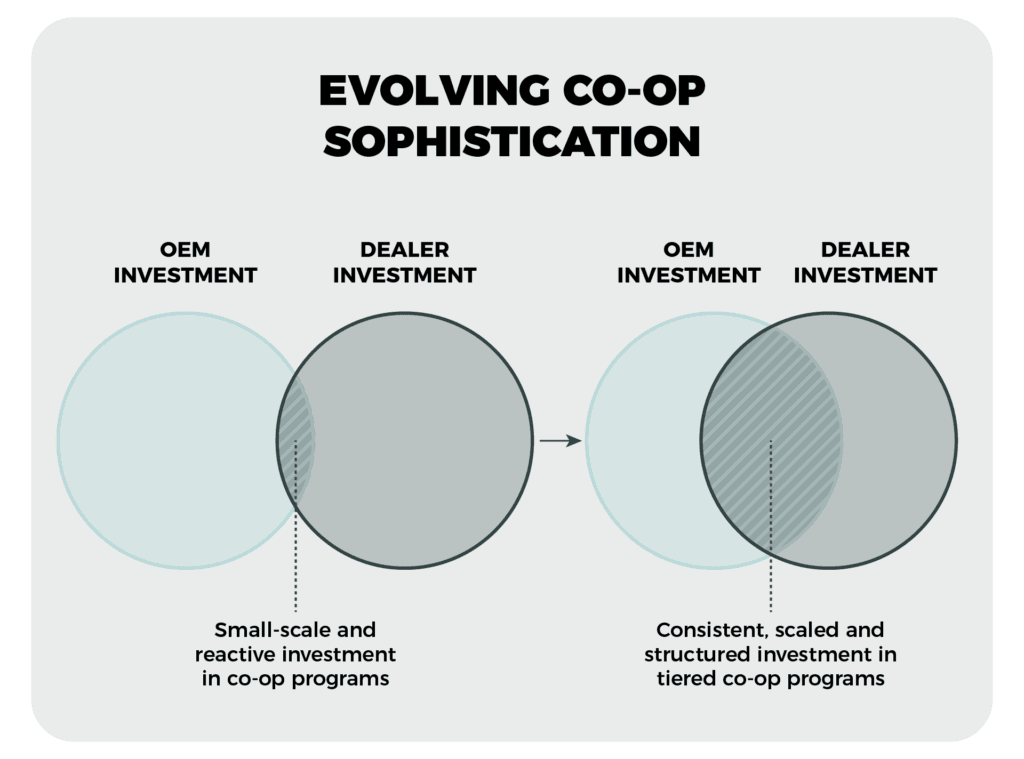
For those early in their co-op journey, there is likely a chasm between how OEMs want their dealers to use funds and how dealers would prefer to use them—visualized below. The idea here is to build your program in a manner that aligns the interests of manufacturer and dealer where co-op dollars are leveraged to serve both parties' interests. There will likely be some use of funds that fall outside the ideal state for each party, but the right program with the right flexibility will close that gap substantially.
Instead of rolling out sweeping changes overnight, test a few approaches on a small scale. Select a range of dealer profiles—some large, some smaller, maybe even a multi-location group—and give them structured yet flexible options.
Consider offering the following:
Track everything closely. Are the new campaigns generating quality leads, increased foot traffic, or higher brand awareness? Are dealers finding it easy to comply with your requirements? Quick feedback loops matter here: if something flops, figure out why and pivot before scaling up.
It’s not enough to run a pilot and hope for the best. You need tangible data to prove that these new co-op strategies are (or aren’t) paying off. Decide on a handful of metrics that matter—like number of leads, cost per lead, or rise in local market share—and keep the focus there.
Share your findings openly with dealers and with leadership. If a particular package is killing it, celebrate that win and roll it out to more dealers. If a customized approach fails, own that outcome, discuss what went wrong, and adjust accordingly. This transparency fosters trust, which is essential if you want your co-op reboot to stick long-term.
Once you’ve gathered enough data, it’s time to refine the program and expand it across your dealer network. By now, you’ll have a good sense of:
Use these learnings to create a more permanent structure with clear guidelines and consistent rules for application, funding tiers, and reporting. Communicate these updates widely and often—through dealer portals, newsletters, or training sessions. Keep the conversation going so the program remains agile enough to respond to new challenges and opportunities down the road.
Upgrading a co-op program isn’t just about spreadsheets and budgets—it’s about alignment, communication, and a willingness to evolve your practices. Leadership must believe in its potential, dealers need to see tangible benefits for their day-to-day business, and you’ll need real metrics to back up every decision.
Yes, it takes effort to shift from a loose, reactive spend to a program with shared goals and clear accountability. But the payoff is enormous. You’ll see stronger dealer relationships, more consistent brand experiences, and a measurable impact on the bottom line. When you move co-op dollars from “necessary evil” to strategic investment, you transform an often-overlooked budget line into a true growth engine for your entire ecosystem.
If you’re feeling that itch to take the leap, start by aligning internally, listening to your dealers’ perspectives, and piloting new ideas on a small scale. Measure your progress, make adjustments, and then roll out the version that truly works. Done right, your co-op program will no longer be a question mark on the balance sheet—it will be an undeniable driver of success for both you and your dealer partners.
Get the latest marketing strategy, brand insights, and industry perspectives delivered to your inbox.